
Kintsugi Meaning: The Japanese Art of Fixing Broken Pottery With Gold
Posted on29 August 2026
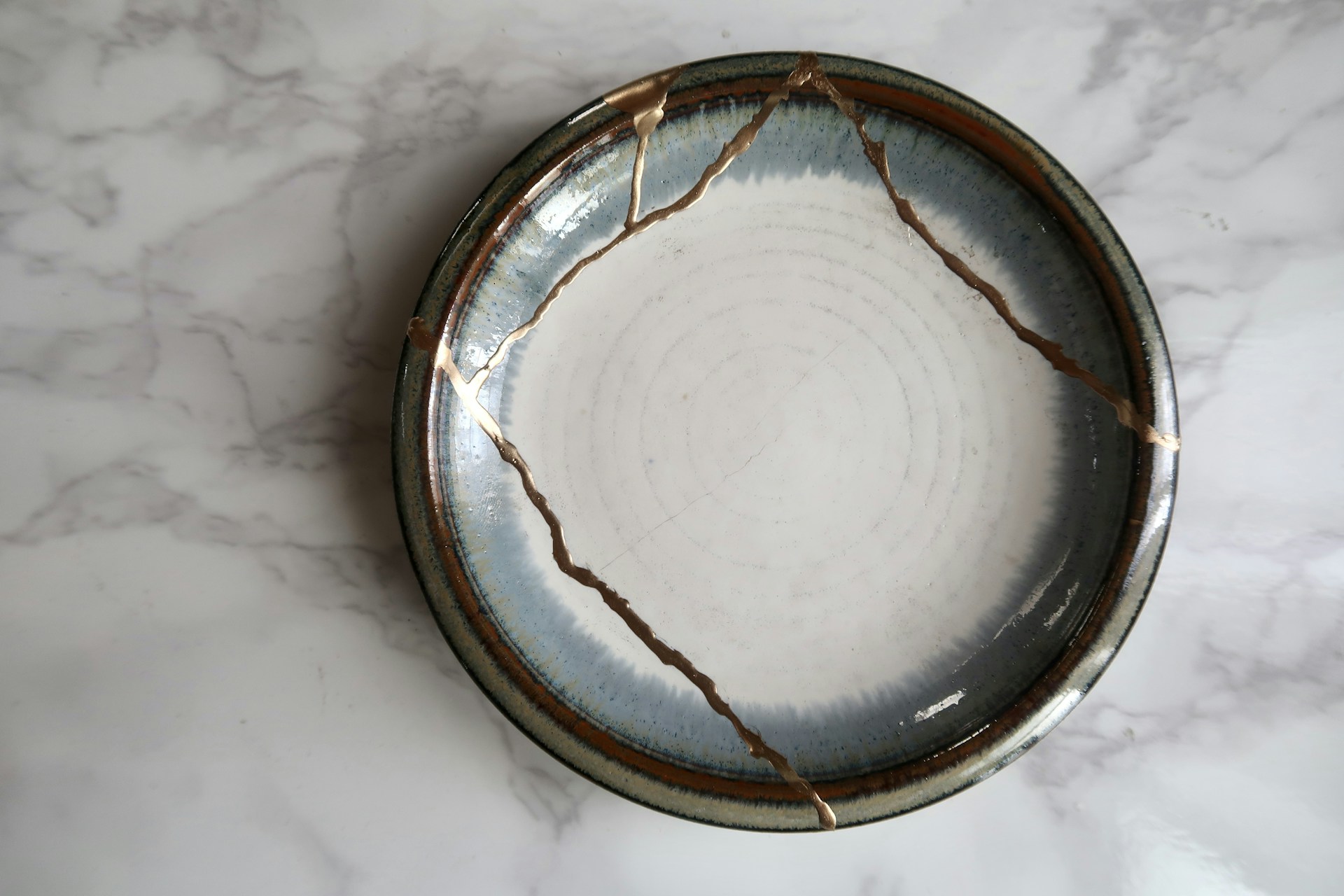
A bowl slips out of your hand and breaks into five pieces. In most of the world, that is the end of the bowl. In Japan there is a four-hundred-year-old craft that treats it as the beginning: the pieces are glued back with lacquer, the seams are dusted with powdered gold, and the repaired bowl is worth more than the one that never fell.
That craft is kintsugi — the Japanese art of fixing broken pottery with gold. This is what the word actually means, where it came from, how the repair is physically done, and why the idea has spread far past pottery.
In this article: what the word means · where it came from · how the repair is done · why a mended bowl is worth more · the metaphor, and its limits · trying it yourself · common questions

Kintsugi Meaning — What the Word Literally Says
Kintsugi (金継ぎ) is two Japanese words joined together: kin (金), gold, and tsugi (継ぎ), joinery or mending. So the literal meaning is "golden joinery" — mending with gold. You will also see it written kintsukuroi (金繕い), "golden repair." The two words describe the same practice.
The important part of the meaning is not the gold. It is the joinery. Kintsugi is not gold-plating a bowl or decorating it with gold paint. It is a structural repair — the bowl was broken, it is now whole again, and the line where it was broken is drawn in a metal you cannot ignore.
Most repair traditions aim at invisibility. A good furniture restorer wants you to be unable to find the join. Kintsugi does the exact opposite: it spends the most expensive material in the workshop on making the damage the first thing you see.
Watch on YouTube: Kintsugi pottery game: a cracked pot sells for MORE
Where Kintsugi Came From
The usual origin story is a fifteenth-century one. The shogun Ashikaga Yoshimasa is said to have sent a cracked Chinese tea bowl back to China for repair, and had it returned stapled together with metal cramps — functional, and ugly. Japanese craftsmen were asked to find a better answer, and the answer was to stop hiding the break.
Treat that story as a story. It is repeated everywhere, and it is not well documented. What is solidly attested is the context it sits in: by the late 1500s, Japanese tea culture had a strong aesthetic preference for objects that were irregular, worn and visibly used, and lacquer repair was already a mature craft. The Japanese art of kintsugi is what happens when a working repair technique meets a culture that had already decided imperfection was worth looking at.
It is worth separating two things that often get merged. Broken pottery has been mended for as long as there has been pottery — with staples, with resin, with rivets, in every culture that ever fired clay. What is distinctive here is not that the pieces went back together. It is the decision to spend gold on advertising where they came apart.
That aesthetic has a name — wabi-sabi, the acceptance of impermanence and imperfection. Kintsugi is often described as wabi-sabi you can hold.
How the Gold Repair Is Actually Done
Real kintsugi is slow. The traditional method — hon-kintsugi — is measured in months, not hours, and the gold is the last five minutes of it.
- Clean and fit. Every fragment is cleaned and dry-fitted, so the craftsman knows the order the pieces have to go back in. A wrong order can lock a piece out.
- Join with urushi. The adhesive is urushi, lacquer tapped from the Toxicodendron vernicifluum tree, usually mixed with rice flour into a paste called mugi-urushi. It is not a glue in the modern sense — it is the same sap used to lacquer bowls and armour.
- Cure in damp air. This is the counter-intuitive step. Urushi does not dry by evaporating; it hardens through a reaction that needs moisture. Pieces go into a damp cabinet called a muro for days or weeks per coat.
- Fill the gaps. Where chips are missing, the void is filled with lacquer thickened with clay or wood powder, then cured again.
- Sand, and repeat. Each cured coat is sharpened back with charcoal or fine abrasive. A single repair can be five to ten cycles of coat, cure, sand.
- Lay the gold. A final thin coat of lacquer is applied along the seam and, at the moment it is tacky, powdered gold is dusted onto it and burnished. The gold sits in the lacquer, not on top of the ceramic.
Silver is used the same way, and that variant has its own name — gintsugi. Platinum, copper and brass all appear too.
One consequence of that timeline is worth stating plainly: authentic kintsugi pottery is expensive because the repair is expensive, not because the gold is. The metal on a seam weighs almost nothing. What you are paying for is months of a craftsman's attention.
Two honest warnings, because the internet is full of the opposite. First, urushi causes a poison-ivy-type skin reaction in most people until it is fully cured; traditional practitioners work with it carefully. Second, most cheap "kintsugi kits" sold online are epoxy and brass or mica powder, not lacquer and gold. They look convincing and they are a genuinely good way to learn the shapes — but a bowl repaired that way should be treated as decorative, not as something to eat or drink from.
Why a Mended Bowl Is Worth More Than a Perfect One
This is the part people find hardest to accept, so it is worth being precise about it. There are three separate reasons, and only one of them is philosophical.
Labour. A hon-kintsugi repair is months of skilled work. The object now contains far more human hours than it did when it left the kiln.
Uniqueness. Two bowls from the same batch are close to interchangeable. The moment one breaks, the crack pattern is unrepeatable — and kintsugi draws that unrepeatable pattern in gold. The repair is a signature no one can copy, including the person who made it.
Narrative. The bowl now carries evidence of something that happened to it. In a tea ceremony, where the history of an object is part of what is being shared, that evidence is not damage. It is provenance.
None of this means "break your pottery to make it valuable." Damage is not the value; the repair is. The distinction matters, and it is the thing most inspirational retellings drop.
Kintsugi as a Metaphor — And Where It Gets Overstretched
Kintsugi has become shorthand in therapy, in recovery writing and in a great deal of motivational posting: you are not less for having broken, the repair is part of you, the scar can be the most beautiful thing about the object.
That reading is a fair one and it is genuinely useful to people. It is also worth knowing that it is a modern, largely Western framing. The craftsmen who developed the technique were solving a practical problem — expensive bowls kept breaking — inside an aesthetic that already valued the imperfect. They were not writing self-help.
Both things can be true. The metaphor is real and it helps people. It is just not where the craft came from, and saying so does not take anything away from either.
Play Goldmend — A Free Kintsugi Pottery Game in Your Browser
If you want to try the real thing, look for hon-kintsugi instruction using genuine urushi and expect it to take months. If you want the shapes and the decisions without the lacquer, a simulation is a reasonable place to start.
We built one. Goldmend is a free browser pottery game where you throw a pot on a wheel, fire it, and mend whatever comes out cracked by tracing the break with a finger while gold pours into it. It is not a craft tutorial and it does not pretend to be — but it does model the one decision kintsugi is actually built on.
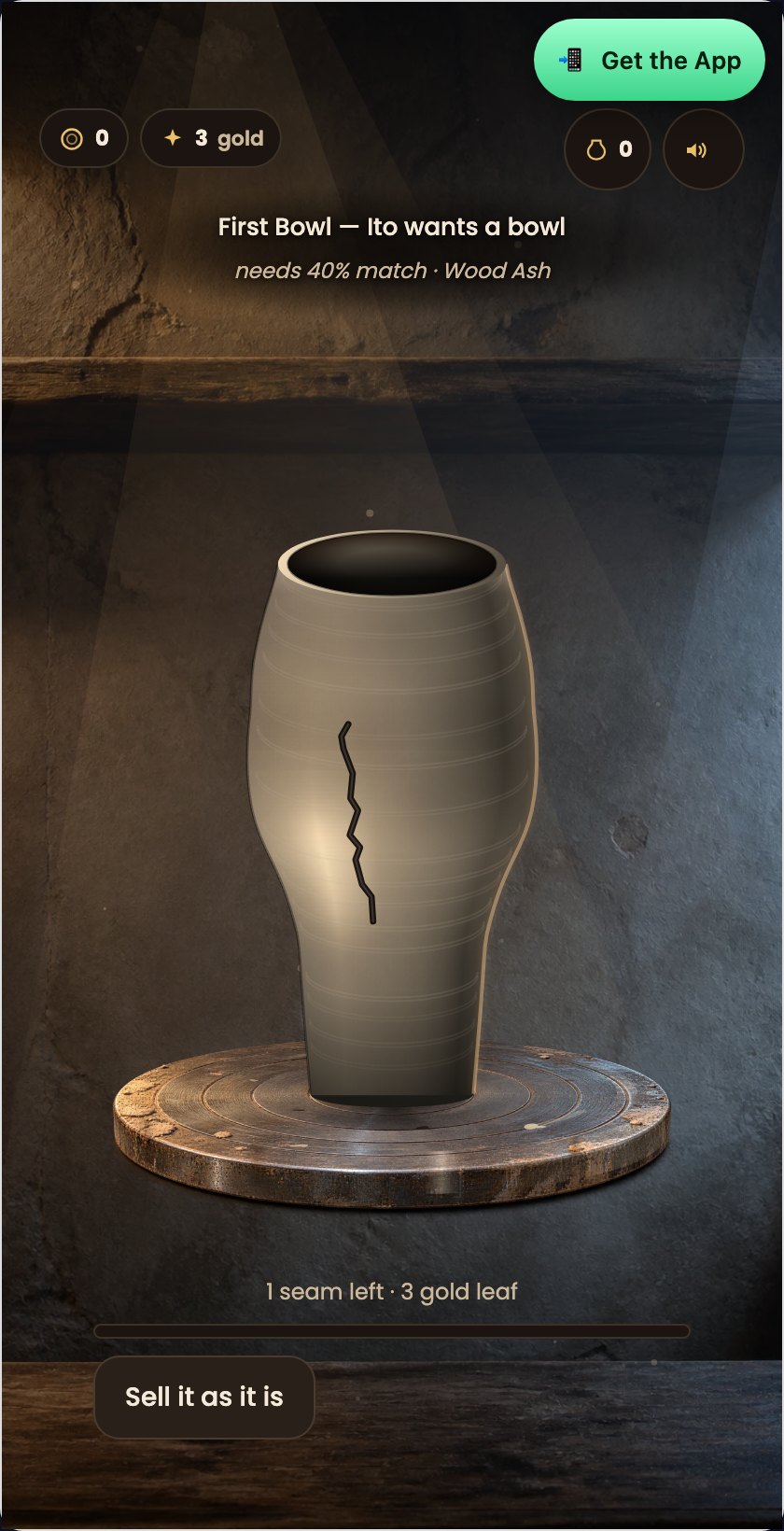
Thin walls make the elegant shapes patrons pay for. Thin walls are also the ones that crack. And a pot that comes out of the kiln broken and gets mended sells for more than one that came out flawless — so the interesting question every round is how much breakage you are willing to invite. Twelve commissions, glazes you unlock by playing rather than paying, and a slow mode where nothing breaks at all.
▶ Play Goldmend free — no download
Works in any browser, on phone, tablet or desktop.
Who Built This — and Can You Hire Us?
Goldmend was made by Teamz Lab. We are a small product team that builds mobile apps, web apps and games end to end — design, build, store release, and the analytics and monetisation behind them. Goldmend is a side project, but it is built on the same stack and the same release pipeline we use for client work, which is why we can point at it instead of describing it.
If you have an idea and want to know what it would actually take to ship it, tell us in a sentence and we will tell you how we would build it. First consultation is free, we sign NDAs when you need one, and you own the source code outright on completion.
If you would rather not wire money to a team you have not worked with before, that is reasonable — you can hire us through our Upwork agency instead and run the whole engagement on escrow, so funds only release against work you have approved.
Work with Teamz Lab
Mobile apps · web apps · games · AI workflows — from idea to store listing.
Common Questions
What does kintsugi mean in English?
"Golden joinery" — kin (gold) plus tsugi (joinery). The variant kintsukuroi means "golden repair."
Is kintsugi food safe?
Fully cured traditional urushi with real gold is generally considered safe for use, but that depends on the craftsman and full curing. Epoxy-and-brass kit repairs are not food safe — keep those pieces decorative.
How long does a kintsugi repair take?
Traditional hon-kintsugi runs from several weeks to several months, because each lacquer coat has to cure in a humid cabinet before the next one goes on. Modern epoxy imitations take a day or two.
Can you do kintsugi on glass?
Yes, and it is done — though glass is less forgiving than ceramic. Lacquer bonds well to a clean glass edge, but the seam is visible through the body of the piece from every angle, so mistakes have nowhere to hide.
Does the gold have to be real gold?
No. Silver (gintsugi), platinum, copper and brass are all used. The tradition is about making the repair visible, not about the specific metal.
Is there a kintsugi game I can play?
Yes — we made one. Goldmend is a free browser pottery game built entirely around the kintsugi idea: throw a pot, fire it, and mend the cracks with gold, where a mended piece sells for more than a flawless one. No download and no sign-up, on phone or desktop.